





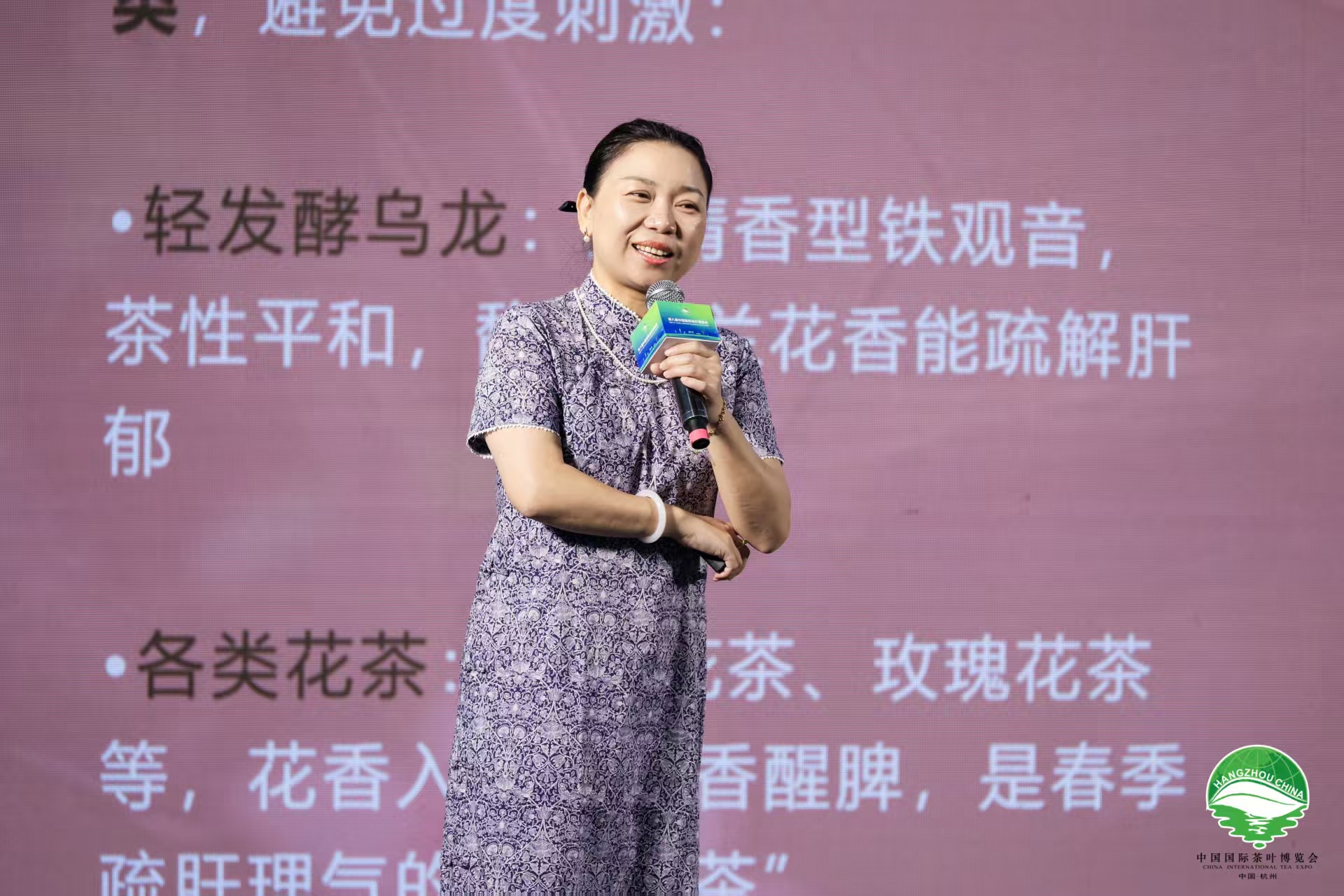
Hangzhou, May 24, 2026 – At the 8th China International Tea Expo, a public lecture titled “The Wisdom of Time: TCM Tea Nurturing Through the 24 Solar Terms” drew a full house. Dr. Zhou Ping, founder of the Tea Evaluation Network, made a major appearance, unveiling for the first time her original and complete academic system of TCM tea nurturing.
Before an audience of over a hundred tea enthusiasts and wellness seekers, many raised their phones to capture the mnemonic chants on the big screen:
“Spring – floral teas to soothe the liver; Summer – green teas to clear heat; Autumn – aged white teas to moisten dryness; Winter – black teas to warm the stomach and yang.”
“Why do some people feel refreshed and energized after drinking tea, while others suffer from bloating, insomnia, or上火 (excessive internal heat)?” Dr. Zhou hit the core issue. “If you drink tea the wrong way, even fine tea can harm you. But if you drink it right, your daily cup becomes a form of wellness.”
Behind this lecture lies more than a decade of exploration, from laboratory to tea mountain. With a Ph.D. in ecology, Dr. Zhou initially worked in technology transfer. While serving tea enterprises, she acutely identified the industry’s pain points: tea knowledge is complex and obscure; the market is filled with contradictory claims and hard-to-verify authenticity; consumers struggle to buy reliable, suitable tea due to information asymmetry; and tea farmers face poor sales channels.
“Consumers find it hard to separate truth from falsehood in a chaotic market, while the disconnect between upstream and downstream chains hinders modernisation,” Dr. Zhou recalled. Based on these observations, she resolved to found the Tea Evaluation Network – a third-party platform bridging origin producers and consumers, connecting the B-end and C-end.
Yet a platform alone proved insufficient. As she delved deeper into the industry chain, she realised the real pain point was not “where to buy tea” but “what tea to drink and how to drink it.” She led her team to build an evaluation system that integrates professional assessment with public participation: hiring senior tea tasters, establishing a collaborative tea efficacy research platform with Fuzhou University, setting up a pesticide residue testing public platform with the Provincial Tea Inspection Station, and collecting real user feedback via online and offline events – all while remaining free of financial ties to any single tea enterprise.
To date, the Tea Evaluation Network has helped nearly 3,000 tea farmers achieve quality certification and market access, and has guided tens of thousands of tea lovers in redefining their understanding of good tea.
The TCM tea nurturing system unveiled at this Hangzhou expo represents Dr. Zhou’s ultimate answer to these challenges. She clearly distinguishes between “TCM tea therapy” and “TCM tea nurturing”: the former uses tea as medicine, focusing on treatment and intervention; the latter uses tea to nourish people in daily life, emphasising harmony, prevention of illness, and a lifestyle that integrates seamlessly with one’s meals and seasons.
Guided by the TCM principle of “treatment based on three factors” (time, place, and individual), Dr. Zhou has created three core pillars: a constitution-tea nature matching model, a Tea Quality Index (TQI) for nurturing, and a 24‑Solar‑Term tea nurturing method. She translates complex TCM theory into everyday wisdom that anyone can grasp: lightly fermented teas tend to be cool; heavily fermented teas tend to be warm; proper processing yields balanced tea properties. The TQI scores tea across three dimensions – aroma, taste, and physical sensation – helping drinkers avoid low-quality teas and truly pay for health.
“The soul of TCM tea nurturing is to follow nature’s rhythm and harmonise with your body constitution,” Dr. Zhou concluded in her lecture. She simplifies the complexity of body types into four categories, enabling everyone to quickly find their ideal tea. Together with the three principles of “plain drinking, mindful drinking, and long-term consistency,” wellness becomes part of daily life.
Looking ahead, Dr. Zhou plans to deepen her work in rock tea (yancha) and aged white tea, explore new directions in TCM tea nurturing, and publish professional books to help more consumers find teas that suit their constitutions. Her vision for China’s tea industry is a thriving ecosystem where technology meets tradition, all links of the value chain collaborate, and consumers can easily access high-quality tea.
From the laboratory to the tea mountains, from a third-party review platform to a TCM tea nurturing system, Dr. Zhou has spent more than a decade walking a path that returns tea to its essence. As she puts it, “Only good tea has healing power.” This cup of Eastern wisdom is now sending its fragrance into thousands of homes.